Parallel Kinematics: Types, History and Applications
Parallel kinematics describes motion systems where a moving platform is supported and driven by several actuators or kinematic elements working in parallel. Compared with serially stacked axes, parallel-kinematic systems can offer high stiffness, low moving mass, compact geometry, and better responsiveness in multi-axis motion applications.
Definition
In a parallel-kinematic mechanism, the moving platform is connected to the base by two or more independent mechanical elements. Motion is created by the coordinated action of several actuators, rather than by stacking one axis on top of another.
This arrangement is common in high-performance robots such as delta robots, motion simulators, precision positioning stages, miniature medical robots, machine tools, and optical alignment systems.
Why It Matters
- High structural stiffness
- Low moving mass
- Compact design for multiple degrees of freedom
- Good dynamic response
- No cumulative bearing stack-up as in serial stages
- Virtual pivot point and coordinate transformation handled by software
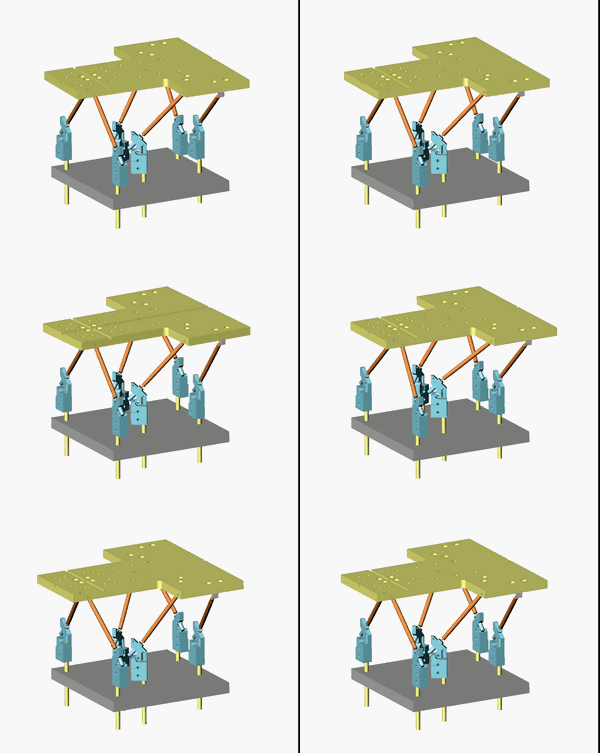
Animation of the fixed-length strut hexapod principle from the F-206 alignment system.
| Type | Description | Typical Applications |
|---|---|---|
| Stewart / Gough-Stewart Platform | Six extensible struts connect a fixed base to a moving platform, enabling six degrees of freedom: X, Y, Z, pitch, roll, and yaw. | Flight simulators, tire testing, vibration simulation, machine tools, optical alignment, hexapods. |
| Hexapod Positioner | A precision implementation of a Stewart-platform-style architecture, usually optimized for metrology, optics, semiconductor, photonics, or research applications. | 6-axis alignment, camera and sensor positioning, telescope optics, beamline instrumentation, photonics packaging. |
| Delta Robot | A lightweight parallel robot with three arms connected to a moving end effector, typically optimized for very fast pick-and-place motion. | Packaging, food handling, electronics assembly, sorting, light automation. |
| Tripod / 3-DOF Parallel Manipulator | Three parallel actuators control a platform, usually for Z motion plus tip/tilt or for translational motion depending on the mechanism design. | Fast steering mirrors, optical alignment, Z-tip-tilt stages, scanning, focusing. |
| Planar Parallel Stage | A moving platform is supported by parallel flexures, air bearings, or guided links to provide motion in X, Y, and sometimes theta-Z. | Wafer positioning, microscopy, metrology, laser processing, inspection systems. |
| Tricept / Hybrid Parallel Robot | A parallel-kinematic structure combined with serial wrist axes, often used where high stiffness and large machining forces are required. | Robotic machining, drilling, trimming, aerospace manufacturing, industrial automation. |
| Parallel-Kinematic Machine Tool | A machine-tool architecture where the spindle or workpiece is moved by parallel links instead of a conventional serial slide stack. | Milling, drilling, machining, large workpiece positioning, precision manufacturing. |
Precision Positioning and Alignment
- Optical alignment
- Photonics packaging
- Laser beam steering
- Camera, sensor, and lens positioning
- Semiconductor inspection and metrology
Industrial Automation
- High-speed pick-and-place
- Packaging and sorting
- Robotic machining
- Drilling, trimming, and assembly
- Flexible manufacturing cells
Simulation and Testing
- Flight simulators
- Driving simulators
- Tire and vehicle testing
- Vibration and earthquake simulation
- Mechanical and materials testing
Research, Medical and Scientific Systems
- Microscopy and life science instruments
- Surgical robots and patient positioning
- Telescope mirror alignment
- Beamline instrumentation
- Vacuum and cryogenic research setups
What Makes a Hexapod Different?
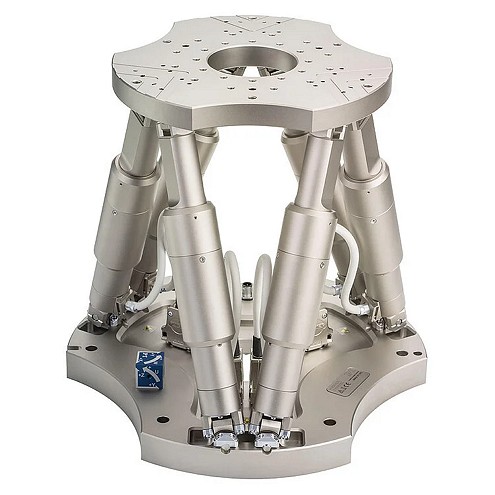
A hexapod is a six-legged parallel-kinematic positioning system. Most precision hexapods are based on a Gough-Stewart-style architecture with six actuators arranged between a fixed base and a moving platform.
The result is coordinated six-axis motion with a software-defined pivot point. This makes hexapods especially useful when a part, optic, sensor, sample, or tool must be positioned in X, Y, Z and also aligned in pitch, roll, and yaw.
Typical Hexapod Uses
- 6-axis optical alignment
- Fiber and photonics alignment
- Semiconductor and wafer metrology
- Laser processing and beamline alignment
- Aerospace and telescope mirror positioning
- Precision assembly and test systems
| Feature | Parallel Kinematics | Serial Kinematics |
|---|---|---|
| Architecture | Several actuators support and move one platform in parallel. | Axes are stacked one after another. |
| Stiffness | Often high because loads are distributed across multiple links. | Can decrease as more axes are stacked. |
| Moving Mass | Can be low because actuators may remain close to the base. | Each upper axis carries the axes above it and the payload. |
| Workspace | Often smaller and more complex, depending on geometry. | Usually simpler and more intuitive for long rectangular travel. |
| Control | Requires coordinate transformation and multi-axis control. | Usually easier to understand axis by axis. |
| Best Fit | Compact multi-axis positioning, 6-DOF alignment, fast dynamics, high stiffness. | Long travel, simple linear positioning, Cartesian gantries, conventional machine axes. |
For precision hexapods and 6-axis parallel-kinematic positioning systems, visit: